
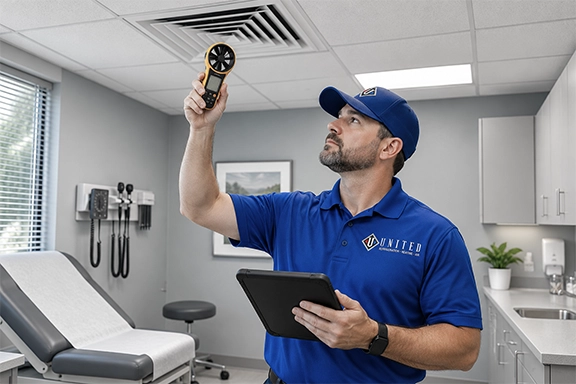
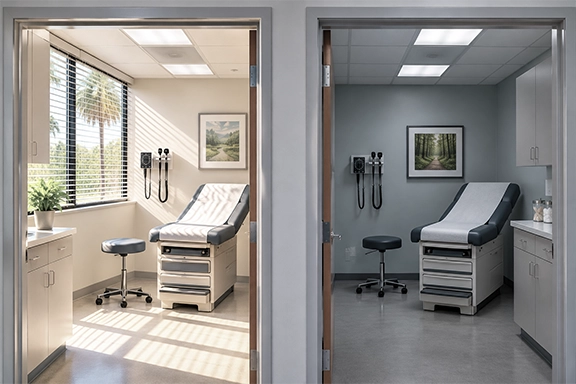
Your waiting room feels comfortable, but one exam room stays warm. Across the hallway, another room feels too cold. Staff adjust the thermostat between appointments, yet the complaints continue.
These medical office HVAC problems often involve more than a thermostat setting. Air distribution, room layout, equipment condition, and humidity can all affect comfort.
For practices in Ocala, The Villages, and Central Florida, identifying the cause helps you choose a practical fix and avoid spending money on changes that leave the same rooms uncomfortable.
Why Does Your HVAC System Cool Exam Rooms Unevenly?
Restricted Airflow and Duct Problems
Each room needs an appropriate supply of conditioned air and a path for air to return to the system. A dirty filter, blocked grille, dirty coil, or damaged duct can interfere with that circulation.
An exam room may also become uncomfortable when its door closes if the return-air path is inadequate. Because privacy requires closed doors, the system should be evaluated under those normal operating conditions.
Duct leaks or poorly balanced branches can leave some rooms receiving less cooling than others.
Thermostat Location and Control Systems
Your thermostat measures conditions at its location. It may not reflect what patients and staff experience inside individual rooms.
A thermostat near a sunny window or heat-producing equipment can call for excessive cooling. One in a comfortable hallway may stop cooling before a warmer exam room reaches a suitable temperature.
Inaccurate sensors, programming errors, or control malfunctions can add to the problem. Repeated adjustments may overcool nearby spaces without resolving the original complaint.
Sunlight, Occupancy, and Medical Equipment
Two similarly sized rooms can have different cooling needs.
An exterior room with afternoon sun may gain more heat than an interior room. Occupancy and medical equipment add heat, too. A busy treatment space may need more cooling during appointments than it does when empty.
When several rooms share one thermostat, those differences can become noticeable. The equipment may be operating, but the distribution and controls may not match each room’s demands.
Renovations and Changes to the Original HVAC Design
A new partition or converted office changes how a space functions. However, its heating and cooling arrangement may remain unchanged.
A room divided into two exam rooms may need revised duct distribution. Relocating a return grille or adding equipment can also affect performance.
Tell your service provider about renovations, even if they happened months before complaints became persistent. The current layout may require adjustments to the original HVAC design.
Could Humidity Be Making Exam Rooms Feel Uncomfortable?
A room can reach its temperature setting and still feel damp or clammy. In Central Florida, moisture entering through doors, building leaks, or outdoor air systems can add to the cooling system’s workload.
Short operating cycles can also limit moisture removal, particularly when equipment is oversized for the load. Lowering the thermostat may leave other rooms colder while dampness continues.
Report recurring condensation, musty odors, or sticky conditions along with temperature complaints. Measuring temperature and humidity together helps distinguish inadequate cooling from a moisture-control problem.
If several rooms suddenly lose cooling, refrigerant, compressor, or electrical issues may also require professional diagnosis.
What Can Your Staff Check Before Scheduling an Inspection?
A few observations can make an inspection more productive:
- Record which rooms feel uncomfortable and when complaints occur.
- Note whether conditions change with doors closed.
- Check for furniture, cabinets, or supplies blocking grilles.
- Record thermostat settings and operating schedules.
- Identify recent renovations or added equipment.
- Report dampness, unusual sounds, leaks, or repeated shutdowns.
Avoid closing vents to force cooling elsewhere. That can change system pressure and create additional distribution problems.
Also avoid repeatedly lowering the thermostat without recording the results. Clear observations help your HVAC professional investigate the cause rather than work from a general complaint that “the building feels hot.”
How Can a Professional HVAC Assessment Identify the Right Fix?
An assessment should compare actual room conditions with how your equipment operates during a normal workday.
Depending on the symptoms, the evaluation may include:
- Room temperatures, humidity readings, and thermostat accuracy.
- Supply and return airflow.
- Filter condition, duct connections, and accessible components.
- Equipment operation, controls, and cooling performance.
- Whether the current layout matches the spaces being served.
The findings should guide the recommendation. Cleaning or repairs may resolve restrictions. Duct repairs and air balancing may improve distribution. Thermostat relocation or additional sensors may address control problems.
Zoning or other design changes may be appropriate when rooms have substantially different needs. Equipment replacement should follow an evaluation of condition, capacity, and performance.
United’s commercial heating and air conditioning services can help you assess recurring comfort issues and prioritize improvements around your practice’s operations.
Do Clinical Spaces Need Special Ventilation or Filtration?
Healthcare facilities can contain rooms with different environmental requirements. Room use and applicable codes determine which ventilation, filtration, and pressure relationships need attention. ASHRAE Standard 170 provides guidance for healthcare environments, including outpatient facilities.
Before changing clinical air delivery, coordinate with the appropriate facility and clinical personnel.
Higher-efficiency filtration must also match equipment capabilities. HEPA filters should not be treated as a simple replacement for an existing filter without evaluating compatibility. EPA recommends professional guidance when determining the highest-efficiency filter a system can accommodate.
These considerations support indoor air quality while keeping comfort improvements appropriate for the space.
Frequently Asked Questions About Medical Office HVAC Problems
Why is one exam room hot while the waiting room stays comfortable?
The rooms may have different cooling demands, duct conditions, or air delivery. A thermostat in the waiting area may also stop cooling before the exam room becomes comfortable.
Will a larger HVAC unit fix uneven temperatures?
Not necessarily. More capacity does not correct blocked ducts, poor distribution, or inaccurate controls. Oversizing can also contribute to short cycling and inadequate humidity control. Evaluate the existing system before choosing replacement equipment.
Can preventive maintenance help prevent uneven cooling?
Yes. Maintenance can identify dirty components, restrictions, and developing equipment faults. Persistent problems caused by room layout, duct distribution, or controls may require additional corrections.
United’s commercial HVAC maintenance plans provide scheduled opportunities to identify concerns before they become recurring disruptions.
Get Help With Uneven Exam Room Temperatures
Your staff should not have to manage daily comfort complaints through constant thermostat adjustments.
United Refrigeration, Heating & Air provides HVAC services for medical facilities in Ocala, The Villages, and surrounding Central Florida communities.