
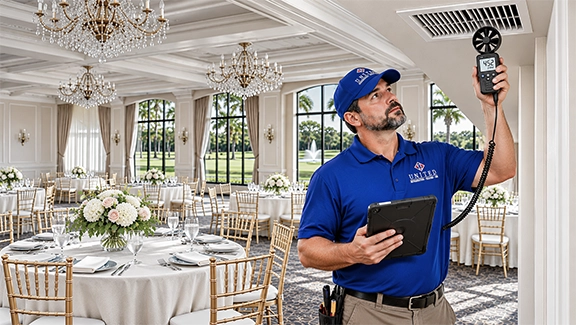
Your venue feels comfortable during setup. Tables are ready, vendors are finishing, and the thermostat shows the expected temperature. Then guests arrive, dinner begins, and complaints start.
Banquet hall air conditioning must handle conditions that change throughout the booking. An empty building does not place the same demands on equipment as a full reception with dancing, food service, and frequent door openings.
If your country club or event venue repeatedly overheats, the cause may involve operating schedules, humidity, air distribution, or equipment performance.
Why Does a Comfortable Venue Get Hot When Guests Arrive?
Every guest adds heat and moisture. As attendance increases, your equipment must remove that additional load while continuing to handle heat from outdoors.
Dancing increases activity. Lighting, audiovisual equipment, and food-service appliances can add more heat. A wedding that moves from seated dinner to a crowded dance floor changes conditions again.
The challenge becomes greater when cooling starts late or equipment already struggles under normal use.
Your posted occupancy limit is not a guarantee that the existing equipment can maintain comfort under every layout and operating condition. Renovations, changes in use, and equipment deterioration can affect performance.
When you host a large gathering, compare the expected activities and attendance with how the venue has performed during similar bookings.
What Common Problems Affect Banquet Hall Air Conditioning?
Cooling Starts Too Late
An unoccupied schedule may allow the building to warm up between bookings. Walls, furnishings, and other surfaces can retain heat even after cooling resumes.
If startup occurs shortly before guests arrive, the system may be trying to recover while people and equipment add heat.
Review the schedule with your service provider. The appropriate preparation time depends on weather, building conditions, equipment, and anticipated attendance. There is no universal startup time that works for every venue.
Also confirm that an automatic schedule will not switch back to an unoccupied setting during an evening reception.
Doors and Catering Access Introduce Heat and Humidity
Deliveries, patio access, and doors held open during setup allow warm, humid air inside.
Coordinate unloading and exterior access with caterers and rental vendors. Keep doors closed when practical, while maintaining required exits and access.
If complaints increase when kitchen exhaust operates, the relationship between exhaust and replacement air deserves attention. Unbalanced systems can draw unconditioned air through doors and building gaps.
Decorations and Layout Changes Restrict Air Distribution
Draping, displays, temporary partitions, and staging can obstruct supply or return grilles.
A layout that looks ideal for a wedding may interfere with conditioned air reaching occupied areas. Changes can leave some sections uncomfortable while the thermostat remains satisfied elsewhere.
Include grille locations in setup planning. Ask vendors to keep them clear, and report whether complaints follow particular layouts.
Equipment or Controls Cannot Meet the Demand
Dirty filters, dirty coils, duct problems, or equipment faults can reduce available cooling. Inaccurate sensors or poor thermostat placement can also affect operation.
A unit may appear adequate when the venue is empty but struggle once occupancy rises.
Do not assume a larger replacement will solve the problem. First establish whether the cause is equipment condition, distribution, controls, or capacity.
Could Humidity Be Making Guests Feel Hotter?
A damp space can feel uncomfortable even when its temperature appears reasonable.
Guests introduce moisture, and exterior access can bring in more. Your equipment must manage both temperature and humidity as conditions change.
Record both measurements during a busy wedding, rather than relying on the thermostat alone. Note whether discomfort occurs throughout the venue or near particular doors and activity areas.
Repeatedly lowering the setting may leave some sections cold without correcting moisture removal.
Our article on clubhouse humidity problems explains how equipment operation, building conditions, and moisture sources can interact.
What Should Your Team Check Before the Next Event?
A preparation checklist gives staff clear responsibilities and creates useful information for a service assessment.
Before the next booking:
- Confirm the schedule. Allow appropriate preparation time and verify operation continues through cleanup.
- Record conditions. Check temperature and humidity in occupied areas before and during the gathering.
- Review the layout. Keep supply and return grilles clear.
- Coordinate access. Discuss deliveries and exterior door use with vendors.
- Report warning signs. Flag leaks, unusual sounds, weak air delivery, or recurring shutdowns.
- Keep a service contact available. Clarify who reports problems and authorizes work.
Rental planning should also preserve access to equipment and controls.
Track when complaints begin, expected attendance, weather, and the activities underway. These observations are more useful than a general report that the building became hot.
Our country club HVAC maintenance guide explains how to coordinate inspections and service around member activities and bookings.
When Should You Request a Professional Assessment?
Request an assessment when overheating repeats despite reasonable schedule and setup adjustments. Arrange it before a busy booking period so there is time to investigate and complete recommended work.
The evaluation may include equipment performance, controls, air distribution, humidity, and the cooling demands created by occupancy and activities.
Where catering kitchens are involved, exhaust and replacement air may need evaluation together.
United’s restaurant HVAC and fresh-air upgrade in Lady Lake illustrates that relationship. The restaurant project addressed failed equipment, negative pressure, and duct distribution through an engineered redesign. It demonstrates why replacing equipment alone may not address every building problem.
Ask for findings that distinguish maintenance needs, repairs, control adjustments, and potential design changes.
Frequently Asked Questions
How early should you start cooling before a wedding?
Timing depends on the building, outdoor conditions, equipment, and expected attendance. Review performance from previous bookings and establish a schedule with your service provider rather than choosing an arbitrary number of hours.
Will lowering the thermostat cool the space faster?
On conventional equipment already operating at full cooling output, a lower setting does not add capacity. Persistent overheating needs investigation. Staff should follow agreed operating settings instead of making repeated large adjustments.
Can portable equipment solve recurring overheating?
Temporary cooling may help in some situations, but it needs suitable capacity, power, drainage, and a way to discharge heat. Equipment placement must preserve access and exits. It should not replace diagnosis of recurring performance problems.
Keep Your Central Florida Venue Comfortable
Your venue needs dependable comfort from setup through the final dance.
United Refrigeration, Heating & Air serves country clubs and commercial properties in Ocala, The Villages, and surrounding Central Florida communities.