
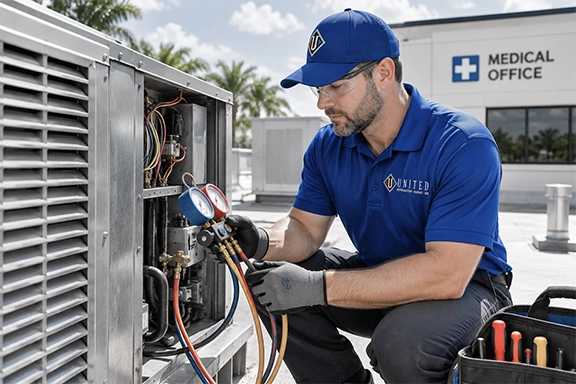
Your waiting room feels comfortable, but an exam room stays warm. Staff keep adjusting the thermostat, and a recurring leak threatens to take another room out of service.
These problems can disrupt appointments long before your equipment stops working. Medical office HVAC maintenance helps you catch developing issues, coordinate repairs, and plan equipment decisions around your practice’s schedule.
For medical offices and clinics in Ocala, The Villages, and Central Florida, consistent comfort starts with understanding what your equipment needs.
What HVAC Challenges Do Medical Offices Face?
Medical office buildings contain spaces with different cooling demands. A crowded waiting area, an interior treatment room, and an office with afternoon sun may need different airflow and temperature control.
Long operating hours and Florida’s humidity add to those demands. Renovations, new partitions, and additional equipment can also change how well the original HVAC design serves your practice.
Unlike a standard office, a medical setting may include clinical spaces with specific environmental requirements. Your service contractor should understand how each space is used before recommending changes.
Common Medical Office HVAC Problems and Their Warning Signs
Uneven Temperatures and Weak Airflow
If one room stays warm while another feels too cold, repeatedly changing the thermostat may make complaints worse elsewhere.
Restricted filters, dirty coils, duct problems, or control issues could be responsible. Changes to room layouts can also affect air distribution.
What to do: Record which rooms have problems and when they occur. A technician can use those observations to investigate the cause before recommending repairs or system upgrades.
Excess Humidity and Condensation
Your building can reach its thermostat setting and still feel damp. Moisture around vents, recurring condensation, or musty odors deserve attention.
Possible causes include drainage problems, excess outdoor moisture entering the building, or equipment that cools quickly without adequately removing moisture.
What to do: Request an assessment of temperature and humidity control. Lowering the thermostat alone may not address the underlying problem.
Filtration and Ventilation Problems
A filter that is dirty, poorly fitted, or unsuitable for the equipment can affect airflow and indoor air quality. Blocked supply or return grilles can create additional problems.
Ventilation also needs attention, particularly after renovations or changes in occupancy.
What to do: Have filter selection, fit, replacement frequency, and outdoor air components checked. Higher-efficiency filtration must be compatible with the system’s airflow capabilities.
Drainage Problems and Unexpected Shutdowns
Clogged condensate lines, damaged drain pans, worn components, and electrical faults can interrupt cooling or cause water damage.
Repeatedly resetting equipment without addressing the cause can allow a small problem to continue.
What to do: Report recurring shutdowns, leaks, unusual sounds, or persistent performance changes. Early diagnosis gives you more opportunity to schedule work before a system failure disrupts appointments.
What Should a Preventive Maintenance Program Include?
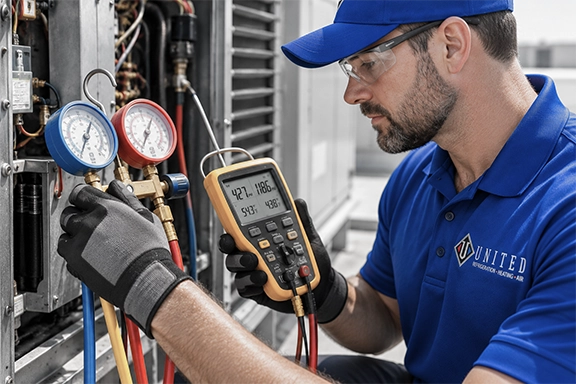
An effective maintenance program should address equipment condition, performance, and developing problems.
Depending on your equipment and service agreement, inspections should include:
- Checking filters and confirming proper fit.
- Inspecting and cleaning coils.
- Checking drain pans and clearing condensate lines.
- Inspecting electrical connections and moving components.
- Testing thermostats, sensors, and operating controls.
- Checking operating pressures and overall performance.
- Observing airflow and checking relevant ventilation components.
- Providing written findings and repair recommendations.
Ask for clear documentation identifying what needs attention now and what can be planned for later. This helps facility managers prioritize spending and track recurring concerns.
United’s commercial HVAC maintenance plans provide scheduled inspections and maintenance options based on your building and equipment needs.
How Can You Schedule HVAC Service Without Disrupting Patient Care?
Planning service around your practice can help limit downtime. Before work begins:
- Identify affected areas. Confirm which rooms or systems may be unavailable.
- Choose appropriate timing. Arrange planned shutdowns outside appointments where practical.
- Coordinate building access. In leased office buildings, clarify responsibilities with property management.
- Discuss clinical precautions. Follow your facility’s infection control protocols when work affects patient care areas.
- Keep records accessible. Maintain equipment details, service history, and unresolved issues.
- Establish an emergency contact. Know whom to call and how staff should report an HVAC failure.
CDC guidance recommends coordinating HVAC work with infection-control staff where appropriate in healthcare facilities. Your practice’s clinical leadership should determine any patient-related precautions.
Clear communication between your practice, building management, and maintenance teams makes planned work easier to manage.
Do Medical Offices Have Special HVAC Requirements?
Requirements vary by room use, facility classification, and applicable codes. A waiting room, procedure room, and airborne infection isolation room should not automatically be treated alike.
ASHRAE Standard 170 addresses ventilation in healthcare facilities, including outpatient environments. Applicable requirements must be evaluated for the particular space; one air change rate or filtration recommendation should not be applied across an entire facility.
For example, negative pressure serves a specific purpose in certain specialized rooms. It is not a general requirement for every medical office.
Routine maintenance supports reliable operation, but it does not replace a qualified evaluation of clinical HVAC requirements.
Frequently Asked Questions About Medical Office HVAC Service
How often should a medical office HVAC system be serviced?
United offers three annual commercial maintenance options:
- Two visits: Two full preventive maintenance visits, scheduled in spring and fall.
- Four visits: Two full visits plus two basic visits for quarterly service.
- Six visits: Two full visits plus four basic visits for service every other month.
Your operating hours, equipment condition, manufacturer guidance, and facility needs help determine the appropriate schedule. United can assess your office HVAC system and recommend an option that fits your practice.
Can routine maintenance improve indoor air quality?
Maintenance can support indoor air quality by addressing filter condition, airflow restrictions, dirty components, and moisture problems. However, it cannot guarantee clean air or replace other infection control measures in healthcare environments.
When should you consider replacement instead of another repair?
Consider an assessment when breakdowns repeat, repair costs increase, or comfort problems continue after service. Equipment condition, parts availability, and changing room use also matter.
United’s commercial heating and air conditioning services can help you evaluate repair and replacement options.
Schedule Medical Office HVAC Service in Central Florida
Your practice needs dependable cooling and a clear plan for keeping it that way.
United Refrigeration, Heating & Air provides HVAC services for medical facilities across Ocala, The Villages, and surrounding Central Florida communities.