
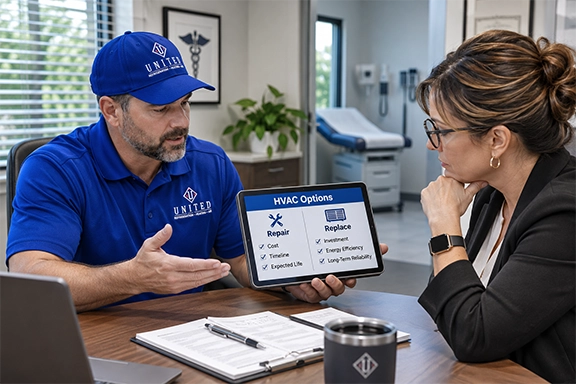
Another breakdown leaves your staff rearranging appointments while you wait for a service diagnosis. The equipment starts running again, but you are left wondering how much longer you should keep investing in it.
Medical office HVAC replacement requires looking beyond the latest invoice. Equipment condition, reliability, operating costs, and your practice’s needs all affect the decision.
For medical offices in Ocala, The Villages, and Central Florida, a professional assessment can help you decide whether to keep the existing equipment or plan a replacement before another failure disrupts your schedule.
When Does Repairing Your Medical Office HVAC System Make Sense?
An isolated problem does not automatically justify replacing an otherwise dependable HVAC system.
Repair may be reasonable when the cause is clearly diagnosed, parts are available, and the equipment has no other significant problems. Remaining warranty coverage can also affect the cost.
Ask your service provider to explain:
- What failed and why.
- Whether the proposed work addresses the underlying cause.
- What other components show deterioration.
- Whether the equipment otherwise meets your practice’s needs.
For example, replacing a failed control component may be practical if the equipment consistently maintains comfortable conditions.
However, restoring operation and resolving ongoing performance problems are different goals. If rooms remain damp or uncomfortable after service, ask whether additional evaluation is needed.
What Signs Suggest It Is Time for Medical Office HVAC Replacement?
Breakdowns Are Becoming More Frequent
One service visit tells you less than a pattern of recurring failures.
Review the past year’s service history. Have different components failed? Are the same symptoms returning? Have emergency calls become a regular expense?
Consider the effect on your practice, too. An unreliable unit may leave rooms unavailable, require appointment changes, or pull staff away from their normal responsibilities.
Repeated breakdowns make it worthwhile to compare continued spending with a planned replacement.
Major Work Requires a Larger Investment
A substantial component failure deserves a broader equipment review before you authorize the work.
Ask about the condition of the remaining components, warranty coverage, and parts availability. Spending heavily on one component may offer limited value if other expensive problems are already developing.
There is no single cost percentage that makes replacement correct for every practice. Request a written comparison based on the equipment’s actual condition and the proposed scope.
The System No Longer Meets Your Practice’s Needs
Your office may have changed since the equipment was installed.
Additional exam rooms, longer operating hours, new equipment, or increased occupancy can change cooling demands. Persistent temperature differences or excess humidity may indicate that the current arrangement needs attention.
However, new equipment alone may not resolve duct restrictions, poor controls, or ventilation problems. Identify those causes before deciding what to replace.
How Should You Compare Repair and Replacement Costs?
Compare both options over the same planning period rather than looking only at today’s bill.
For the existing equipment, consider the proposed work, other known problems, warranty coverage, and maintenance needs. Past spending helps reveal a pattern, but money already spent should not determine the decision by itself.
For replacement, request a complete installation quote that identifies:
- Equipment and controls included.
- Duct, electrical, or drainage modifications.
- Removal and disposal of existing equipment.
- Required permits and inspections.
- Startup, testing, and warranty terms.
Include potential business disruption in your evaluation. Staff time, unavailable rooms, and rescheduled appointments matter even when they do not appear on a contractor’s invoice.
Ask how any projected energy savings were estimated. New equipment can offer efficiency improvements, but actual results depend on selection, installation, operating conditions, and maintenance.
United’s commercial heating and air conditioning services include equipment assessments and replacement options for commercial properties.
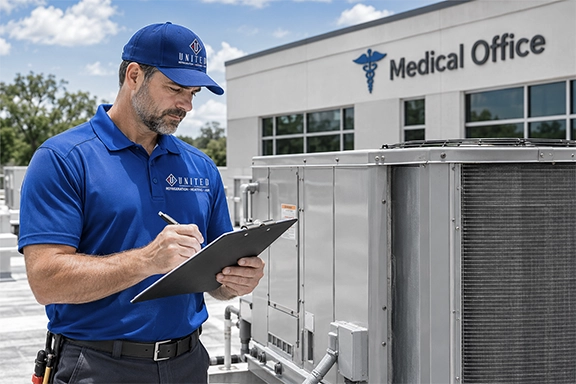
What Should a Replacement Assessment Include?
A technician should evaluate how the existing HVAC system serves your current practice before recommending new equipment.
That assessment should consider room use, operating schedules, occupancy, and heat-producing equipment. It should also address duct condition, air distribution, controls, drainage, and electrical requirements.
Humidity deserves specific attention in Central Florida. Explain whether rooms feel damp, condensation recurs, or comfort complaints continue despite reaching the thermostat setting. Ask how the proposed equipment will address moisture removal under your operating conditions.
Capacity should be selected for the building’s needs. Simply matching the old unit’s size can carry an existing problem into the new installation.
Where applicable, review ventilation and any room-specific environmental requirements with the appropriate facility and clinical personnel.
Ask for a recommendation that explains which problems the proposed HVAC solutions address and whether additional building or distribution work is needed.
How Can You Plan Installation Around Appointments?
Planning replacement gives you more opportunity to coordinate access, equipment delivery, and shutdowns before an emergency forces a decision.
Before approving the schedule:
- Identify the rooms served by the affected equipment.
- Confirm the expected shutdown period and any uncertainty.
- Discuss work hours around appointments.
- Coordinate landlord approval and building access.
- Establish clinical precautions for work near occupied areas.
- Confirm how completion and operating performance will be checked.
After-hours work may be an option, but availability and project requirements should be confirmed in advance.
If temporary cooling is proposed, clarify its limitations. It may provide comfort support without meeting every environmental requirement of a clinical space.
Once installation is complete, arrange ongoing care. United’s commercial HVAC maintenance plans offer scheduled service to support equipment performance and identify developing concerns.
Frequently Asked Questions About Medical Office HVAC Replacement
Should you replace equipment based on age alone?
No. Age provides context, but condition, service history, parts availability, and performance matter too. Older equipment may remain serviceable, while a newer unit with significant damage may warrant replacement.
Will new equipment fix uneven exam room temperatures?
Only if the replacement addresses the cause. Duct distribution, thermostat location, room layout, and humidity may require separate corrections. Ask which improvements are included in the proposal.
Can you replace one unit at a time?
Sometimes. Separate units serving different areas may allow phased replacement. Your contractor should confirm equipment compatibility, shared controls, and operational dependencies before recommending that approach.
Discuss Medical Office HVAC Replacement With United
You need a clear explanation of your options before committing to another major expense.
United Refrigeration, Heating & Air provides HVAC services for medical facilities across Ocala, The Villages, and surrounding Central Florida communities.