
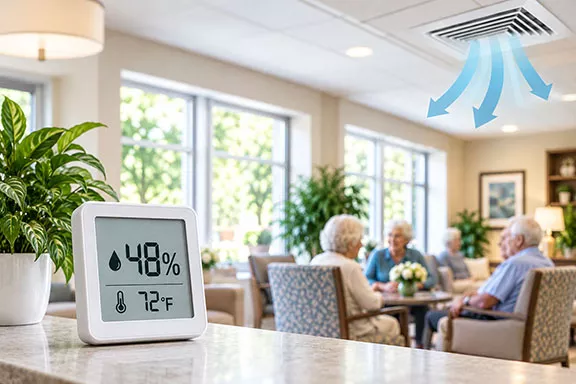
The thermostat says 74 degrees, the air conditioning is running, but part of the building still feels damp or clammy. Maybe there’s a musty odor in one hallway, condensation around a vent, or resident rooms that never seem as comfortable as the rest of the facility.
In Central Florida, it’s easy to blame these conditions on the weather. But persistent humidity inside an assisted living facility deserves a closer look.
An HVAC system does more than cool indoor air. It also plays an important role in removing moisture. When something interferes with that process, a building can reach the desired temperature while the humidity level remains uncomfortable.
Understanding the cause is the first step toward effective humidity control.
High Humidity Can Create Problems Throughout the Facility
Temperature and moisture work together to influence how a space feels.
High indoor humidity can contribute to clammy conditions, condensation, musty odors and moisture on building surfaces. Persistent moisture can also create conditions that support mold growth.
For senior living facilities, these are important building-management and comfort concerns. Resident rooms, dining areas, hallways and common spaces may operate under different conditions, making moisture problems more noticeable in some areas than others.
Humidity is also one factor that can influence indoor air quality, along with ventilation, filtration, building conditions and sources of indoor contaminants.
In a senior living environment, questions about air quality may be particularly important because residents can include people with asthma, COPD, other respiratory issues or compromised immune systems. However, HVAC equipment, a humidifier, dehumidifier or HEPA filtration should not be presented as preventing respiratory illness or controlling a specific virus. Indoor air concerns should be evaluated based on the facility’s actual conditions and needs.
What Causes High Humidity in an Assisted Living Facility?
There isn’t one universal cause. A moisture problem can involve the HVAC equipment, ventilation, building conditions or several factors working together.
1. HVAC Equipment Isn't Removing Enough Moisture
Air-conditioning equipment removes moisture as indoor air passes across the cooling coil.
If the system isn’t operating correctly, has an airflow problem or doesn’t run under the conditions needed for adequate moisture removal, indoor humidity may remain high even though the thermostat reaches its set temperature.
This is why a room can feel cool and clammy at the same time.
The temperature displayed on the thermostat only tells part of the story.
2. The HVAC System May Be Improperly Sized
Bigger isn’t always better.
An oversized cooling system may satisfy the thermostat quickly and shut off before providing enough runtime for effective moisture removal under certain conditions.
That doesn’t mean oversized equipment is responsible for every high-humidity problem. Equipment sizing is one potential cause that should be evaluated along with system operation, controls, airflow and building conditions.
3. Ventilation and Florida Outside Air
Commercial buildings need ventilation, but outdoor air in Central Florida can carry a significant moisture load.
How outside air enters the building, how much is introduced, whether it is properly conditioned and how the building is pressurized can all affect the indoor humidity level.
Exhaust systems can influence this balance as well. When air leaves the building, replacement air has to come from somewhere.
For senior living facilities, understanding the interaction between cooling equipment and outside air can be an important part of diagnosing persistent moisture problems.
4. HVAC Maintenance Problems
Restricted airflow, dirty coils, filter problems, controls and other maintenance issues can interfere with system performance.
Condensate drainage deserves attention too. Cooling equipment removes moisture from the air, and that water needs to drain properly.
Regular HVAC maintenance provides an opportunity to identify developing problems before they become larger comfort or equipment issues.
Lean about: HVAC Maintenance for Assisted Living Facilities: Common Problems, Risks & Prevention
5. The Problem May Not Be HVAC
Not every moisture problem starts with the air-conditioning system.
Roof or plumbing leaks, doors that frequently open, window problems, moisture intrusion and other building-envelope conditions can contribute to high indoor humidity.
Changes to the facility can matter as well. Renovations, additions, occupancy changes or modifications to exhaust and ventilation systems can change how a building behaves compared with when the original HVAC system was designed.
A good diagnosis considers the entire building rather than assuming the cooling equipment is automatically responsible.
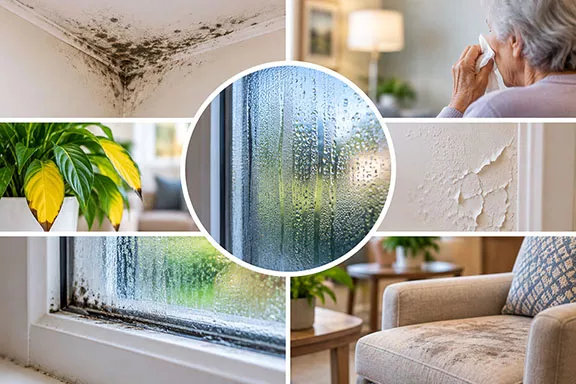
Signs of a Humidity Problem
Facility staff may notice warning signs before anyone measures the actual relative humidity.
Common signs include:
- Rooms that feel cool but clammy
- Musty odors
- Condensation around vents, windows or other surfaces
- Persistent dampness
- Moisture appearing in specific areas
- Significant differences between wings or rooms
- HVAC equipment that frequently cycles
- Spaces that never seem comfortable despite acceptable temperatures
These symptoms don’t identify the cause by themselves. They indicate that conditions should be investigated.
Measuring temperature and humidity in affected areas provides more useful information than relying entirely on how the room feels.
Why Is One Part of the Facility More Humid Than Another?
An assisted living facility isn’t one uniform space.
A resident wing can have different conditions from a dining area, office, kitchen or common room. Different areas may have different occupancy levels, sun exposure, outside-air requirements, exhaust, thermostat settings and HVAC equipment.
One area may also receive more outdoor air because exterior doors open frequently.
These differences are one reason a facility-wide moisture problem shouldn’t be diagnosed from a single thermostat or humidity reading.
Finding the cause may require comparing conditions in different areas and determining what equipment serves each space.
Will Lowering the Thermostat Fix High Humidity?
Not necessarily.
When a room feels humid, the natural response may be to turn down the thermostat. But making the space colder doesn’t automatically correct the underlying moisture problem.
The result can sometimes be a room that feels cold and clammy instead of warm and humid.
If the humidity level remains excessive, the better approach is to determine why moisture isn’t being adequately controlled.
That could involve equipment performance, airflow, ventilation, controls, outside air or another building condition.
How HVAC Systems Help Control Indoor Humidity
Effective moisture removal depends on several parts of the system working together.
Cooling performance, coil conditions, airflow, runtime, controls and ventilation can all influence how much moisture is removed from indoor air.
Depending on the cause of the problem, an HVAC contractor may need to evaluate:
- Equipment operation and condition
- Airflow
- Cooling coils
- Controls and thermostat operation
- Outside-air ventilation
- Condensate drainage
- Equipment sizing
- Building pressure and exhaust
- Actual temperature and relative humidity
The right solution depends on what that evaluation finds.
In some applications, dedicated dehumidification may be appropriate. In others, correcting an existing equipment, control or airflow problem may provide the answer.
Likewise, humidification is used when indoor conditions are too dry. Adding a humidifier to a building experiencing excessive moisture would obviously work against the goal.
The important principle is simple:
Measure the conditions. Identify the cause. Then determine the solution.
Indoor Air Quality Is More Than Humidity
Maintaining proper humidity can be part of an overall indoor air quality strategy, but it isn’t the entire strategy.
Indoor air can also be influenced by ventilation, filtration, occupancy, cleaning practices and contaminant sources inside or outside the building.
Airborne particles and other IAQ concerns may require different approaches depending on their source. There isn’t one HVAC product or filter that solves every air quality concern.
For senior facilities, that means humidity should be evaluated as one part of the overall living environment rather than treated as a stand-alone health solution.
Indoor Air Quality & Ventilation in Assisted Living Facilities
When Aging HVAC Equipment Contributes to Humidity Problems
Older equipment doesn’t automatically need replacement because a facility has a moisture problem.
First determine what’s causing the problem.
However, when an aging HVAC system has persistent humidity problems along with recurring repairs, declining performance or reliability concerns, it may be time to evaluate whether continued repair remains the best option.
Repair or Replace an HVAC System? A Guide for Assisted Living Facilities
Maintenance history can be particularly useful here. It allows facility managers to see whether the moisture problem is new, recurring or part of a larger decline in equipment performance.
Don't Guess at the Cause of High Humidity
A high-humidity complaint can quickly generate proposed solutions:
Lower the thermostat. Install a bigger air conditioner. Add a dehumidifier. Change the filter.
Any of those recommendations made without understanding the cause can miss the actual problem.
Humidity in a commercial building can involve equipment operation, sizing, airflow, ventilation, controls, outside air, building conditions—or several of these factors at once.
That’s why diagnosis should come before equipment recommendations.
Humidity Problems at an Assisted Living Facility?
If resident rooms, hallways, dining areas or other parts of your facility feel unusually humid, don’t assume it’s simply part of living in Florida.
United Refrigeration, Heating & Air can evaluate HVAC operation, airflow, equipment condition and other factors that may be contributing to excessive indoor moisture.
Call United Refrigeration, Heating & Air to discuss humidity or HVAC problems at your assisted living facility.