
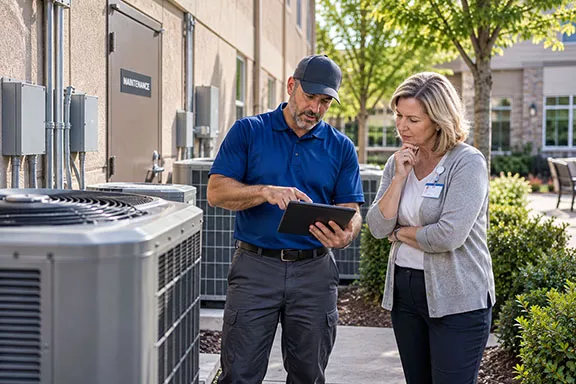
An assisted living facility rarely has HVAC equipment that is all the same age or in the same condition. One system may be relatively new, another may have years of reliable service left, and an older unit serving a resident wing may be requiring repairs more frequently.
When that older HVAC system needs another repair, an important question comes up: Does it make sense to repair it again, or is it time to plan for replacement?
Age matters, but it shouldn’t make the decision by itself.
For assisted living facilities, HVAC repair and replacement decisions should consider equipment condition, repair history, system performance, the area being served, and the consequences if the equipment unexpectedly fails.
Taking that broader view helps facility managers prioritize aging HVAC units instead of treating every piece of equipment the same.
Why HVAC Replacement Decisions Are Different in Assisted Living Facilities
The consequences of an HVAC breakdown depend partly on where the equipment is located and what area it serves.
A system serving an administrative area may present a different operational risk than equipment serving resident rooms, dining areas, or other frequently occupied spaces.
That’s particularly important in senior living, where resident comfort is part of normal facility operations. Older adults may also be more sensitive to temperature extremes, making reliable heating and cooling an important consideration when evaluating aging equipment.
This doesn’t mean every older air conditioner or heat pump should automatically be replaced. It means the importance of the area being served should be considered alongside the mechanical condition of the equipment.
HVAC Equipment Age Matters-But It Doesn't Tell the Whole Story
There isn’t one equipment age at which every commercial HVAC system should automatically be replaced.
Two systems of the same age can have very different histories.
One may have received regular HVAC maintenance, experienced few repairs, and continue to provide reliable indoor comfort. Another may have recurring failures, declining performance, or difficulty controlling temperature and humidity.
Instead of looking at age alone, consider:
- Equipment age and overall condition
- Maintenance and repair history
- Frequency and cost of repairs
- Availability of replacement parts
- System performance
- Comfort or humidity problems
- Energy usage
- Importance of the area being served
The goal isn’t to replace older HVAC equipment simply because it is old. It’s to determine when continued repair remains practical and when system replacement should become part of the facility’s plan.
Internal link: HVAC Maintenance for Assisted Living Facilities: Common Problems, Risks & Prevention
There isn’t one equipment age at which every commercial HVAC system should automatically be replaced.
Two systems of the same age can have very different histories.
One may have received regular HVAC maintenance, experienced few repairs, and continue to provide reliable indoor comfort. Another may have recurring failures, declining performance, or difficulty controlling temperature and humidity.
Instead of looking at age alone, consider:
- Equipment age and overall condition
- Maintenance and repair history
- Frequency and cost of repairs
- Availability of replacement parts
- System performance
- Comfort or humidity problems
- Energy usage
- Importance of the area being served
The goal isn’t to replace older HVAC equipment simply because it is old. It’s to determine when continued repair remains practical and when system replacement should become part of the facility’s plan.
Internal link: HVAC Maintenance for Assisted Living Facilities: Common Problems, Risks & Prevention
7 Signs It May Be Time to Consider HVAC System Replacement
No single warning sign automatically means an HVAC system needs replacement. Several problems occurring together, however, can make a stronger case for evaluating the equipment as a whole.
1. HVAC Repairs Are Becoming More Frequent
An occasional HVAC repair is normal over the life of commercial equipment. Repeated repairs deserve a closer look.
If technicians are returning to the same unit frequently, consider its complete service history rather than evaluating each repair as an isolated event.
2. Repair Costs Are Increasing
A repairable HVAC system isn’t necessarily a system worth repairing indefinitely.
As equipment ages, compare the frequency and cost of repairs with its overall condition and expected reliability. There isn’t a universal dollar amount that makes replacement the right choice.
The better question is: Does continued investment in this particular system still make operational and financial sense?
3. The System Is Becoming Unreliable
Reliability has real value in senior care facilities.
Even when individual repairs remain possible, an HVAC system experiencing repeated breakdowns can become an operational problem. Emergency service calls also give facility managers less control over timing and how affected spaces are managed.
If management no longer trusts a system to operate reliably, replacement planning deserves consideration.
4. The HVAC System Struggles to Maintain Comfort
Long runtimes, temperature complaints, weak airflow, and hot or cold areas can indicate a problem that needs diagnosis.
These symptoms don’t automatically mean replacement is necessary. Problems involving controls, filtration, ventilation, ductwork, or other components may be repairable.
However, recurring comfort problems combined with aging equipment and repeated repairs can change the repair-versus-replace calculation.
Humidity should be considered as well. In Central Florida, HVAC equipment needs to do more than reach the thermostat setting. Moisture control also contributes to indoor comfort and building conditions.
Go in-depth on learning about: Humidity Control in Assisted Living Facilities
5. Replacement Parts Are Becoming Difficult to Obtain
Older HVAC equipment can sometimes remain technically repairable while becoming increasingly difficult or expensive to support.
Parts availability can affect both repair costs and downtime. That becomes especially important when the system serves a heavily occupied area where waiting for a difficult-to-source component creates additional disruption.
6. A Major Component Has Failed
A compressor, coil, or other major component failure creates a natural decision point.
Instead of asking only, “Can this be repaired?”, ask:
“Does making this repair still make sense considering the age, condition, and history of the entire system?”
Sometimes repair will still be the practical choice. In other cases, putting substantial money into aging equipment may be difficult to justify.
7. Energy Usage Is Increasing
Older or poorly performing equipment can contribute to higher energy bills, although rising energy costs alone don’t prove that a system needs replacement.
Weather, occupancy, operating schedules, and other equipment can also affect energy consumption.
When increasing energy usage appears alongside long runtimes, declining performance, and recurring repairs, energy efficiency becomes another factor worth considering.
When Repairing the HVAC System Still Makes Sense
Replacement isn’t always the best answer.
Continuing to repair a system may make sense when:
- The equipment has otherwise been reliable
- The repair is relatively minor
- Replacement parts remain readily available
- The HVAC equipment is in good overall condition
- The system continues to meet the area’s cooling needs
- There isn’t a pattern of recurring failures
A properly maintained HVAC system shouldn’t be written off simply because it has reached a certain age.
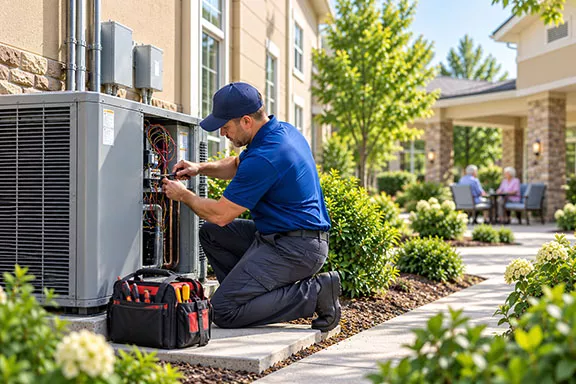
A commercial HVAC contractor should be able to explain both options when appropriate: what is involved in repairing the existing equipment and what facility management should consider if replacement is becoming the better long-term decision.
Don't Treat Every HVAC Unit at a Senior Living Facility the Same
This is particularly important for larger senior living facilities and living communities.
A property may operate packaged units, split systems, heat pumps, central AC, or other commercial HVAC configurations. Some facilities may also use HVAC zoning or VRF systems to serve different areas.
The system type matters, but so does the role each unit plays within the facility.
A useful way to evaluate individual systems is:
Age → Condition → Repair History → Performance → Area Served → Operational Risk
An older unit in good condition with minimal repair history may remain a relatively low priority.
Another unit of similar age serving a resident wing may have repeated failures and declining performance. That system could deserve much greater attention.
This approach allows owners and operators to prioritize equipment based on risk rather than age alone.
Use HVAC Maintenance Records to Make Better Decisions
Good records make repair-versus-replace decisions easier.
Regular maintenance creates a history showing which systems require repairs, where recurring problems are developing, and which equipment is becoming less reliable.
Useful records may include equipment age, area served, maintenance history, repair costs, comfort problems, equipment condition, and previous emergency service calls.
Without that history, a replacement decision can become heavily influenced by the most recent breakdown. With better records, facility managers can evaluate system performance over time.
Learn About United Heating & Air’s Commercial HVAC Maintenance Plans
Build an HVAC Replacement Priority List
For assisted living facilities with multiple HVAC units, replacement planning doesn’t need to begin with replacing everything.
Instead, classify equipment by condition and operational risk:
Monitor: Equipment is operating reliably with no significant concerns.
Plan: Aging equipment or developing problems should be included in future budgeting discussions.
High Risk: Equipment has recurring failures, poor condition, increasing repair costs, or serves an area where a breakdown could cause significant disruption.
Replacement Candidate: The combination of condition, repair history, performance, and operational risk makes replacement a practical option to evaluate.
This approach can help facility managers prioritize available capital and avoid treating every older system as an equally urgent problem.
Planned HVAC Replacement vs. Emergency Replacement
There is a major difference between planning an HVAC replacement and being forced into one after a breakdown.
A planned replacement gives the facility time to evaluate equipment options, energy efficiency, HVAC design, budget, installation scheduling, and the layout and cooling needs of the affected area.
Depending on the application, that may include evaluating high-efficiency or energy-efficient HVAC equipment, controls, smart thermostats, or other HVAC upgrades.
The goal isn’t to install new technology simply because it’s available. Improvements should make sense for the building and application.
An emergency replacement starts with a different question:
How quickly can we get this area operational again?
That urgency can limit the time available to compare options and coordinate installation around facility operations.
Preventive planning won’t eliminate every breakdown, but identifying higher-risk equipment early gives management more control over major replacement decisions.
Planned HVAC Replacement vs. Emergency Replacement
Facility managers don’t need to wait for equipment to fail before thinking about replacement.
A commercial HVAC evaluation can help determine:
- Which systems remain in good condition
- Which systems are requiring more repairs
- Which equipment is becoming less reliable
- Which units serve areas where failure would cause the greatest disruption
- Which systems should enter future replacement planning
For assisted living facilities, the goal should be to keep reliable equipment operating while identifying higher-risk systems early enough to plan for what comes next.
Not Sure Whether to Repair or Replace an HVAC System?
An aging HVAC system doesn’t automatically need replacement. But recurring repairs, declining performance, parts availability, equipment condition, and the consequences of another breakdown should all factor into the decision.
United Refrigeration, Heating & Air works with assisted living facilities and other commercial properties throughout Central Florida to maintain, diagnose, repair, and replace commercial HVAC equipment.
If you’re dealing with an aging system—or trying to determine which HVAC equipment at your facility should be prioritized—call United Refrigeration, Heating & Air to discuss your repair and replacement options.