
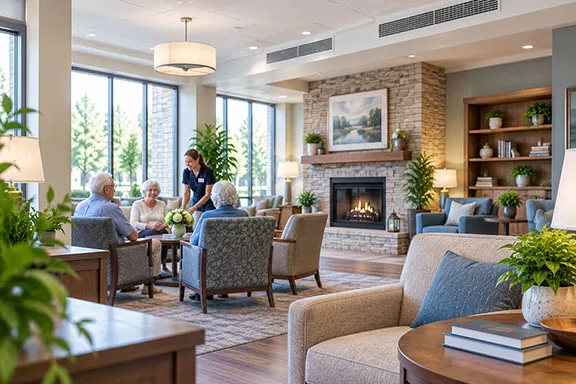
An HVAC system doesn’t have to stop working for a facility to have an indoor air concern.
Facility managers may hear complaints about stuffy rooms, persistent odors, excessive humidity, dust, weak airflow, or one area that simply doesn’t feel as comfortable as the rest of the building.
In senior living facilities, these concerns can quickly lead to questions about indoor air quality (IAQ).
But indoor air quality isn’t controlled by one filter or one piece of equipment. The indoor environment is affected by HVAC operation, ventilation, filtration, humidity, occupancy, building conditions, and sources of pollutants both inside and outside the facility.
Understanding how these factors work together is a better starting point than immediately installing an air purification product.
What Affects Indoor Air Quality in Senior Living Facilities?
Indoor air quality refers broadly to the conditions of the air inside a building and the factors that can affect it.
In senior living, those factors can include:
- Ventilation and outdoor air
- HVAC system operation
- Air filtration
- Humidity
- Airflow
- Building materials and furnishings
- Cleaning and maintenance activities
- Cooking and food-service operations
- Occupancy
- Renovation or construction
- Pollutants entering from outdoors
- Moisture or other building problems
The importance of indoor air quality became much more visible during the COVID-19 pandemic, particularly in healthcare facilities, nursing facilities, and other occupied buildings.
That attention also produced a lot of marketing around filters, air purifiers, and air purification systems.
Those products can have specific applications, but there isn’t one device that solves every IAQ problem. The source and nature of the problem need to be understood first.
Ventilation: Bringing Outdoor Air In Without Creating New Problems
Ventilation is an important part of managing indoor conditions.
Commercial buildings use ventilation to introduce outdoor air and exhaust air from certain spaces. But bringing fresh outdoor air into a building isn’t as simple as opening a vent and assuming more is always better.
In Central Florida, outside air can carry significant heat and moisture. Outdoor air pollution and other environmental conditions can also affect what enters the building.
That incoming air has to be considered as part of the building’s overall HVAC design.
Facility managers may need to consider:
- How much outside air is being introduced
- Where it enters the building
- How it is conditioned
- Exhaust systems
- Building pressure
- Humidity
- HVAC equipment performance
Problems with ventilation and air balance can contribute to comfort differences, humidity problems, odors, and other indoor air quality issues.
This is one reason commercial ventilation should be evaluated as part of the entire building rather than in isolation.
Air Filters Matter—But a Better Filter Isn’t Always the Answer
When someone raises an IAQ concern, one of the first suggestions is often:
“Install a better filter.”
Sometimes improved filtration may be appropriate. But the highest-efficiency filter available isn’t automatically the right filter for every HVAC system.
Filters create resistance to airflow. The HVAC equipment needs to be capable of operating properly with the selected filter.
A dirty filter can create its own problems by restricting airflow and reducing system performance.
Filters can capture certain airborne particles and particulate matter, but filtration doesn’t address every possible pollutant. Gases, odors, excessive moisture, ventilation problems, and pollutant sources may require different approaches.
Likewise, portable air purifiers or more specialized air purification equipment should be selected for a defined purpose rather than treated as a universal solution for poor air quality.
The key point is:
Filtration is one part of indoor air quality—not the entire solution.
Humidity Can Change Indoor Conditions
Humidity has a major influence on how indoor spaces feel.
Excessive humidity can contribute to clammy conditions, condensation, musty odors, and moisture concerns. Persistent moisture can also create conditions that support mold growth.
In Florida senior living environments, humidity deserves particular attention because cooling equipment, outdoor air, ventilation, airflow, and building conditions can all influence moisture levels.
A thermostat can show an acceptable temperature while the room still feels uncomfortable because humidity remains high.
Learn more about: Humidity Control in Assisted Living Facilities: Causes, Risks & HVAC Solutions
Where Do Indoor Air Pollutants Come From?
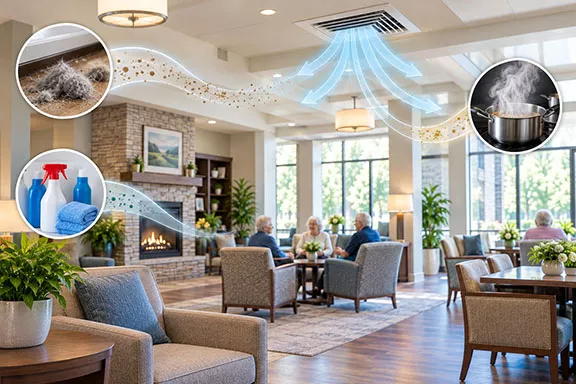
Indoor air pollutants can originate both inside and outside a building.
Potential sources include dust, cooking, cleaning activities, furnishings, building materials, maintenance work, renovation, moisture-related building conditions, and outdoor pollution entering the facility.
Some materials and products can also release volatile organic compounds, while other activities may produce airborne particulate matter.
The important thing for facility managers isn’t memorizing every possible contaminant.
It’s understanding that the source matters because the solution depends on the source.
A different air filter won’t repair a moisture leak.
A dehumidifier won’t necessarily correct a ventilation problem.
And simply increasing ventilation isn’t automatically the right response to every odor or IAQ complaint.
Finding the cause should come before selecting the solution.
Why One Area of a Senior Living Facility May Feel Different
A senior living facility isn’t one uniform space.
Resident rooms, hallways, dining areas, kitchens, offices, activity rooms, and other living spaces may have different occupancy, sun exposure, exhaust requirements, ventilation, equipment, and thermostat settings.
That can result in noticeable differences from one area to another.
Facility teams may encounter:
- Weak airflow in certain rooms
- Stuffy areas
- Temperature differences between wings
- Humidity differences
- Persistent odors
- Doors affected by pressure differences
- Recurring comfort complaints
These conditions don’t automatically prove poor IAQ. They are clues that the HVAC and ventilation systems—or another part of the building—may need to be evaluated.
Kitchens and Other High-Activity Areas Affect Building Airflow
Commercial kitchens and other exhaust-heavy areas deserve special attention.
When an exhaust fan removes air from a building, replacement air has to come from somewhere. Properly designed make-up air helps replace exhausted air while supporting the intended pressure and airflow within the building.
If exhaust and make-up air aren’t working together properly, the effects can extend beyond the kitchen.
Building pressure, comfort, outdoor-air infiltration, and humidity can all be affected.
This makes kitchen ventilation part of the broader HVAC picture in assisted living facilities with commercial food-service operations.
United Heat & Air Offers: Cookline Exhaust & Make-Up Air Fans
What About Respiratory Concerns?
Senior care facilities serve older adults, including residents who may have asthma, pulmonary disease, or other chronic health conditions. Understandably, facility operators may receive questions about the air residents breathe and whether HVAC improvements can provide a healthier living environment.
This is an area where claims should be made carefully.
Indoor air quality can involve airborne particles, humidity, ventilation, filtration, and other factors, but an HVAC product shouldn’t be presented as preventing disease or treating a respiratory condition.
Instead, facility managers should focus on maintaining the building and its HVAC systems appropriately and addressing identified IAQ problems based on their actual source.
Specific health concerns should be addressed by qualified healthcare professionals.
Signs Your HVAC or Ventilation System Should Be Evaluated
Some conditions warrant a closer look at how the building is operating:
- Persistent musty or unusual odors
- Excessive humidity or condensation
- Weak airflow
- Stuffy rooms
- Significant temperature differences
- Recurring comfort complaints
- Filters becoming unusually dirty
- Areas that consistently behave differently from the rest of the facility
- Changes following renovations or building modifications
None of these symptoms alone establishes that a facility has poor indoor air quality.
They provide a starting point for determining whether the HVAC system, ventilation, building conditions, or another source is contributing to the problem.
HVAC Maintenance Supports Better Indoor Conditions
Regular HVAC maintenance can help identify issues that affect indoor conditions before they become larger problems.
That includes checking filters, coils, condensate drainage, airflow, controls, equipment operation, and other components.
Maintenance also provides an opportunity to identify patterns.
If the same wing repeatedly experiences humidity or airflow problems, for example, the issue deserves more investigation than repeatedly addressing the symptom.
HVAC Maintenance for Assisted Living Facilities: Common Problems, Risks & Prevention
For senior living communities with multiple pieces of HVAC equipment, planned maintenance also provides a more organized way to document equipment condition and developing problems.
Don’t Start With an IAQ Product—Start With the Problem
When a facility has an indoor air concern, it’s tempting to immediately look for a product:
Better filter. Air purifier. Dehumidifier. More ventilation.
But the right solution depends on what’s actually happening inside the building.
A better process is to evaluate:
Temperature → Humidity → Airflow → Ventilation → Filtration → HVAC Operation → Building Conditions
Then determine what needs to be corrected.
Sometimes the answer may involve filtration or air purification. Other times it may be an HVAC repair, ventilation adjustment, humidity problem, maintenance issue, or building condition.
Diagnosing the problem first helps avoid investing in equipment that doesn’t address the underlying cause.
Indoor Air Quality Concerns at Your Senior Living Facility?
United Refrigeration, Heating & Air helps assisted living and senior living facilities evaluate HVAC, ventilation, humidity, airflow, and indoor comfort concerns throughout Ocala, The Villages, DeLand, and communities across Central Florida.
If your facility is experiencing persistent humidity, airflow, ventilation, or indoor comfort problems, call United Refrigeration, Heating & Air to discuss what you’re experiencing and schedule HVAC service.