
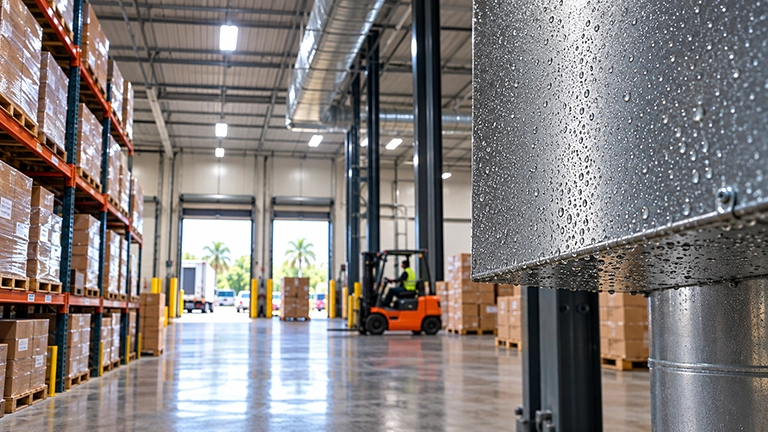
Your building reaches its temperature setting, but cartons feel damp, metal surfaces develop moisture, or certain storage areas smell musty. Turning down the thermostat hasn’t solved the problem.
For owners and facility managers, warehouse humidity control involves more than keeping a building cool. You need conditions that support your inventory, equipment, employees, and daily operations.
Whether you manage a smaller commercial storage building in Ocala or a large industrial facility elsewhere in Central Florida, identifying where moisture enters—and how your mechanical systems handle it—is the starting point.
Why Is Your Warehouse Humid When the AC Is Running?
An HVAC system can reach its temperature setting without removing enough moisture to meet your storage requirements. This can happen when cooling demand is low but moisture continues entering through loading docks, air leaks, or ventilation.
Equipment sizing, operating schedules, control settings, and maintenance condition also affect performance. A system that cycles off quickly may provide insufficient moisture removal.
Lowering the thermostat alone can waste energy without addressing the cause. A useful assessment considers both humidity and temperature, along with equipment operation throughout the day.
Where Do Warehouse Moisture Problems Start?
Central Florida’s humid air can enter during deliveries, loading operations, and routine access. Frequently opening doors increases the amount of outside air your equipment must manage.
Other potential sources include:
- Gaps around dock doors, roof penetrations, and exterior walls.
- Roof leaks, plumbing leaks, or poorly draining equipment.
- Wet pallets, incoming materials, and cleaning activities.
- Unbalanced exhaust fans drawing untreated outdoor air inside.
- Changes in operations that exceed the original system’s design assumptions.
The location and timing of a humidity problem provide useful clues. Conditions that worsen during deliveries suggest a different investigation than moisture appearing after rain or overnight shutdowns.
How Can Excess Humidity Affect Stored Goods?
Persistent dampness can contribute to packaging deterioration, corrosion on metal parts, and damage to moisture-sensitive inventory. Mold and mildew may develop where materials remain damp, creating odor and indoor air quality concerns.
Condensation occurs when a surface is cold enough for water vapor in the surrounding air to collect on it. The relevant threshold is the dew point. Cold products, pipes, or building surfaces can therefore become wet even when the overall space does not feel unusually warm.
Watch for softened cartons, rust, wet surfaces, recurring odors, and inventory complaints. Investigating these signs early can help protect stored goods before product damage becomes a recurring expense.
Common HVAC Problems That Contribute to Warehouse Humidity
If your warehouse feels cool but packaging is damp or condensation keeps returning, your HVAC system may be reaching the temperature setting without adequately removing moisture. Common contributing problems include:
- Short cycling: Frequent starts and stops can limit moisture removal, especially when equipment is oversized or controls are malfunctioning.
- Airflow problems: Dirty filters, blocked returns, duct restrictions, or incorrect fan settings can interfere with cooling and dehumidification.
- Dirty evaporator coils: Buildup reduces heat transfer and can restrict airflow, affecting the system’s ability to manage humidity.
- Drainage issues: Clogged drain lines or poorly draining pans can cause standing water, leaks, and moisture returning to the airstream.
- Incorrect refrigerant charge: Low refrigerant can reduce performance and contribute to coil icing. A technician should check the charge and investigate potential leaks.
- Outside air intrusion: Open loading docks, worn door seals, building gaps, and unbalanced exhaust systems can bring humid Florida air inside.
- Temperature-only controls: A standard thermostat may shut off cooling before the space reaches the humidity level your stored goods require.
What Humidity Level Should You Maintain?
There is no single humidity level that fits every warehouse environment. The correct target depends on the type of goods, packaging, storage temperature, and applicable product specifications.
Relative humidity, expressed as RH, describes how close air is to saturation at its current temperature. Because temperature changes affect that percentage, evaluate readings together rather than treating one measurement as the full picture.
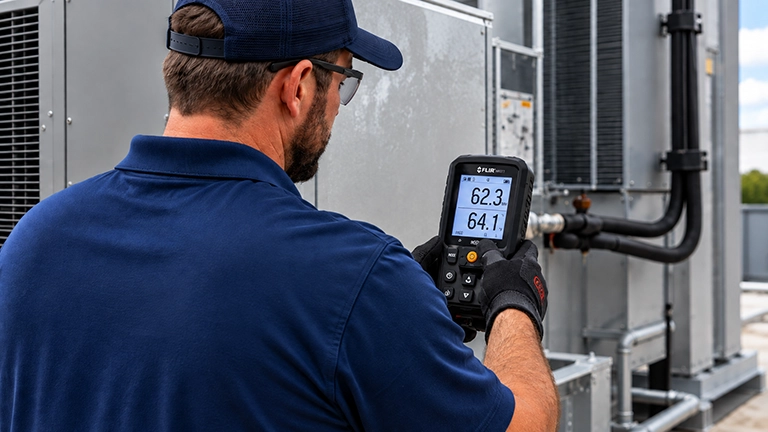
Start with your manufacturers’ storage requirements. Then measure indoor humidity levels in representative locations, including loading areas, perimeter spaces, and zones with recurring complaints. Monitoring over time can reveal fluctuation that a single thermostat reading misses.
Some specialized operations also need protection against low humidity. Commercial humidifiers add moisture; they do not solve excessive moisture. Humidification should only be considered when documented storage or process requirements call for it.
How Do Small and Large Facilities Differ?
In a smaller building, one system may serve the entire storage area. Door activity, sensor placement, and equipment condition can have a substantial effect on the space. Correcting an existing fault may be more appropriate than adding equipment.
Large industrial facilities introduce additional considerations: high ceilings, extensive rack layouts, multiple loading docks, different storage requirements, and several mechanical systems operating together.
An assessment should examine conditions across zones and relevant storage heights. One comfortable office or hallway does not demonstrate consistent humidity throughout the building. Temperature-controlled spaces also require a different evaluation from refrigerated or frozen storage.
Which Humidity Control Solutions Can Help?
Effective humidity control in warehouses begins with measurements and source identification. The solution may combine building repairs, mechanical adjustments, and dedicated equipment.
Correct HVAC and Moisture-Entry Problems
Technicians should evaluate cooling performance, coils, drainage, controls, and operating schedules. Building leaks and damaged door seals need attention too. Otherwise, equipment may continually work against avoidable moisture entry.
Evaluate a Commercial or Industrial Dehumidifier
A dedicated dehumidifier may be appropriate when the required moisture removal exceeds what the cooling equipment can reliably provide.
Refrigerant-based equipment removes water by condensing it on a cold coil. A desiccant dehumidifier uses moisture-attracting material and may suit applications requiring drier air or operation at lower temperatures.
Selection should consider operating conditions, moisture load, energy use, and integration with existing systems. Floor area alone is not enough to size an industrial dehumidifier.
Improve Airflow and Ventilation Management
Air circulation can help distribute conditioned air, but fans alone do not remove water from the building. HVLS fans may improve air movement and comfort for warehouse workers; they do not replace moisture-removal equipment.
Similarly, increasing air changes does not automatically lower humidity. Required ventilation must be maintained, while incoming air and building pressure are managed appropriately.
Can Maintenance Help Keep Humidity Stable?
Routine service helps identify mechanical problems before they disrupt climate control. A maintenance plan should reflect your equipment, operating hours, and storage requirements.
Depending on the system, checks may include:
- Filters, coils, drain pans, and condensate lines.
- Cooling performance and airflow.
- Sensor accuracy and control settings.
- Dedicated moisture-removal equipment.
- Changes in recorded conditions or equipment runtime.
Facility staff can also record recurring moisture issues, door problems, and inventory complaints between visits. These observations help technicians diagnose patterns and recommend practical, energy-efficient improvements.
Learn how United’s commercial HVAC maintenance plans support ongoing equipment care.
Get Help With Warehouse Humidity in Central Florida
Recurring condensation, damp packaging, or inconsistent storage conditions deserve a closer look. Buying larger equipment or changing settings without understanding the cause can leave the underlying issue unresolved.
United Refrigeration, Heating & Air provides commercial HVAC service, maintenance, and climate-management support for Central Florida storage facilities. Whether your property is a smaller commercial building or a large industrial operation, discuss your equipment, operating needs, and moisture concerns with our team.
Explore our storage facility HVAC services or request a service assessment to identify the next steps for your facility.